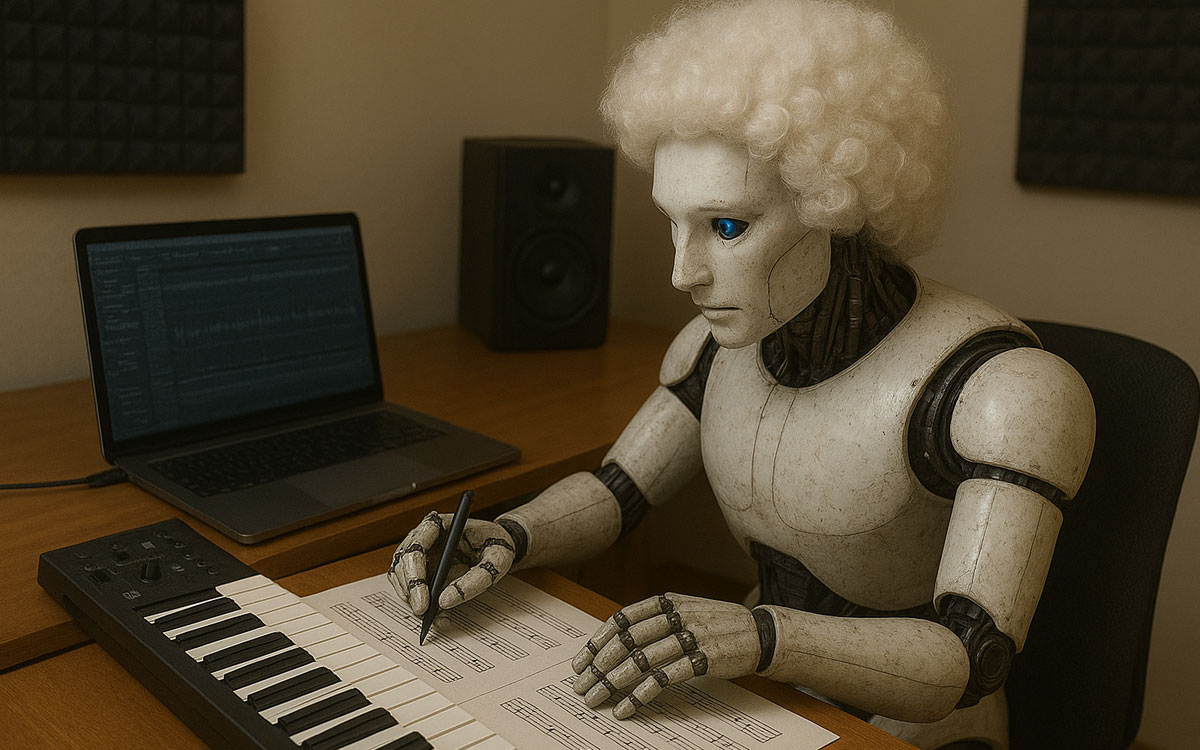
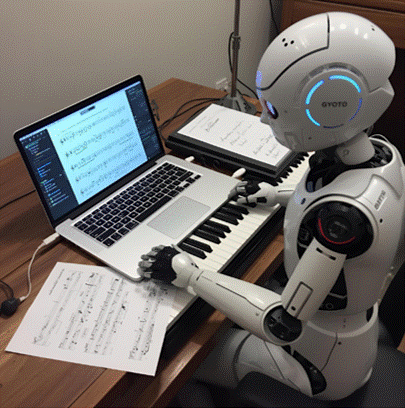
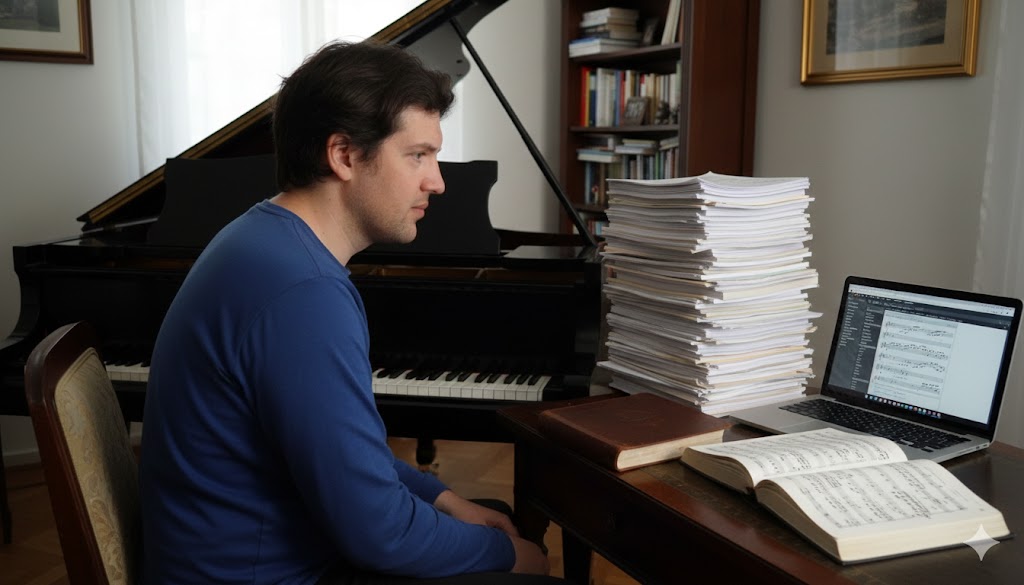
Tools powered by Artificial Intelligence (AI) are everywhere, growing more ubiquitous and efficient all the time. The field of music is no exception. Music making was always up to date with concurrent technology, making the most of new possibilities. Examples are numerous, ranging from nineteenth-century virtuosic writing for mechanically advanced instruments to twentieth-century electronic sound manipulation and twenty-first-century digital tools that allow us to produce high-quality music in our living room. AI will only accelerate this process. Soon enough, many highly specialized crafts associated with music making and music creation—such as using filters, mixing, and even writing full-scale orchestration—will be done with a few mouse clicks and verbal commands. Soon, perhaps, AI will be able to compose an entire score for a cinematic film, or at least large portions of it. Many areas of expertise will become obsolete. Just as I use AI to copyedit this text rather than hiring a copy editor, composers may soon rely on AI for orchestration.
There are, however, downsides. As AI musical capabilities deepen, they will be able to streamline workflow. But reliance on proven models and procedures may come at the expense of creativity, limiting the “personal voice” of the musician to a far narrower landscape of possibilities. Pop music, for instance, is already facing criticism for its growing uniformity; greater dependence on AI, which inherently learns from and systemizes current trends, threatens to cement this lack of diversity.
At a certain point, we may need to rethink what artistic creativity is. Those who know how to exploit and manipulate AI better will have clear advantages. Will this lead to a musical world in which the best artists are the most proficient users of AI-powered tools and musical talent will be secondary to technological abilities? I do not believe so. We already have an example of professional photographers who use AI to achieve the best possible results. Yes, photographers who have adapted and learned to use AI are ahead, but still, their eyes and personal tastes ultimately dictate the results. Musicians will still have to use their ears and aim for certain aesthetic goals. Using AI will be just another required skill. I believe that while we are likely to shift our perspective on artistic creativity, the human touch will still play a significant role. It will be the job of music scholars to analyze how AI sets the trends that shape new works and to seek each artist’s individuality in those works.
Omer Maliniak was awarded a Fulbright Postdoctoral Fellowship to pursue his research on the changing musical syntax and form in eighteenth-century music, from the Baroque stylistic period to the Classical one.
Omer earned his Ph.D. in musicology at Bar-Ilan University under the supervision of Professor Yoel Greenberg, researching the formal evolution of concerto first movements in the eighteenth century from a diachronic perspective and using qualitative measures, unlike the traditional synchronic and qualitative approaches in the field of musical research. The article that stemmed from this research, Maliniak, Omer, and Yoel Greenberg, “Follow the Solo: The Formal Evolution of the Concerto in the Eighteenth-Century,” Music Theory Spectrum 44/2 (2022): 231-259 was selected by the Society of Music Theory for the Outstanding Publication Award.
Aside from his B.A., M.A., and Ph.D. in music, Omer also holds a B.A. in psychology and has a background in cognitive science research.
Alongside his research work, Omer is an educator, teaching in multiple high school music programs, also developing learning materials in several projects on behalf of the Israeli Ministry of Education.