In the quest to engineer self-replicating living blocks—or proteins—“the Corporation” funded the first interstellar vessel in the year 2125.
But why was this venture so critical? Earth, once chemicals-based, is now a biomaterials-based planet. “The Corporation,” the largest company in the world, holds patents based on most synthetic proteins—with applications ranging from construction to biocomputing.
During the first Informatics Age, life scientists analyzed every protein found in nature using mass spectrometers—rudimentary protein readers that plateaued one century after their invention.
Progressing to the next level, the second Informatics Age used Artificial Intelligence (AI) to optimize synthetic readers called nanopores that convert proteins into electrical signals. This enabled a direct reading of the “decorations” that guide protein interaction dynamics. Yet the scope of neural networks is still limited by the training input library. Testing all possible synthetic proteins is economically less viable than funding interstellar travel.
This may sound like science fiction, but we have entered the second Bioinformatics Age. Today, biologists are refining nanopores, a process which will allow us to read complex protein information accurately, inexpensively, and quickly. This is revolutionary. However, compiling a laundry list of proteins is like listing the characters in a play without writing the plot—the plot in this case being represented by protein-protein interactions.
Within the next decade, AI tools like AlphaFold will accelerate biomaterials’ research. AI’s ability to predict protein-protein interactions will increase in sophistication, enabling the creation of synthetic protein complexes. However, structural biology limits AlphaFold to modeling only a dozen proteins at any one time. Thus, a new approach to making synthetic complexes is needed.
Systems biology could use mathematical terms to summarize how 3,000-plus proteins interact with one another. As in physics, we will need equations to describe biology in space and time.
After studying biophysics, I moved to Israel to learn about mathematical models with Professor Uri Alon. I’m grateful to Fulbright Israel for funding my work; finding the equations that govern life. I hope to one day reach my goal of using synthetic proteins to design programmable cells.
Bio
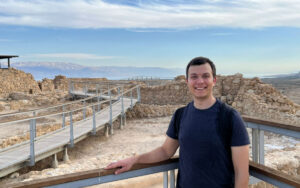
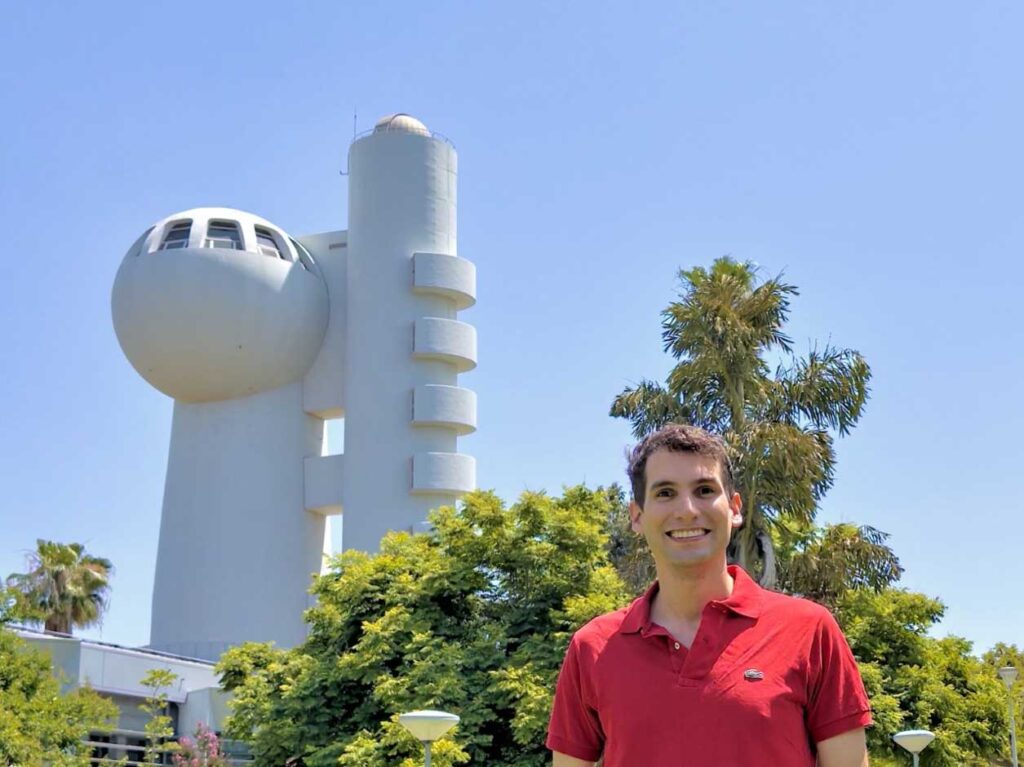
Rafael Deliz-Aguirre was awarded the Fulbright Postdoctoral Fellowship at the Weizmann Institute of Science, where he will work with Professor Uri Alon. Rafael’s research uses interdisciplinary approaches to advance translational medicine. His goal is to improve disease diagnosis and therapies. For this project, Rafael will apply complex systems physics to mathematically model patient samples analyzed with spatial proteomics.
Rafael earned a BS in biology from Baylor University and an MS in biology from Texas A&M International University. He then completed a doctoral degree in theoretical biophysics at Humboldt University of Berlin in collaboration with the Max Planck Society. He has also worked at a medical clinic in South Texas and conducted research at the University of Texas MD Anderson Cancer Center.
Beyond his research, Rafael is passionate about global health and has participated in conferences organized by the United Nations and the Organization of American States.