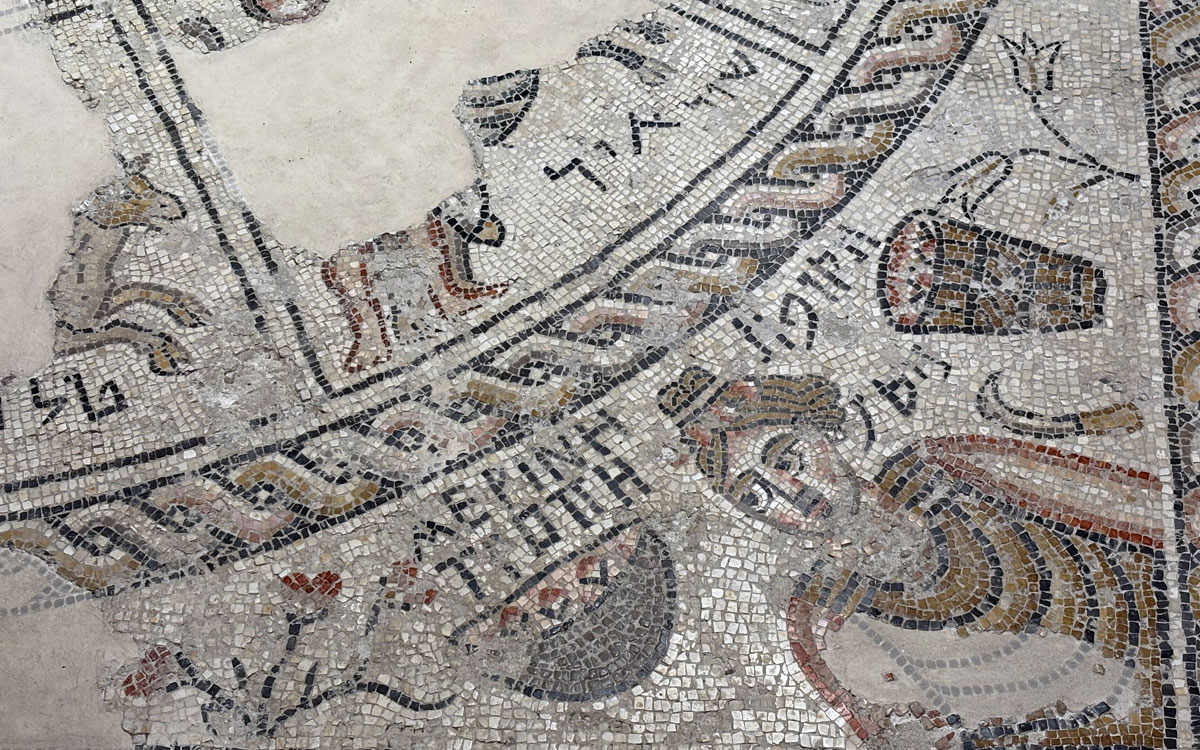
Mosaic floor and wall decorations—made of small pieces of colored glass or stone held in place by plaster or mortar—populated private houses and villas, streets and agoras, bathhouses, shops, churches, synagogues, and, later, mosques in the late Roman and early Byzantine world of the fourth to eighth centuries CE. They featured a broad range of visual themes, combining patterns, images, and inscriptions, serving as an important medium of communication and an identity marker for groups, institutes, and individuals. Mass-produced in local and regional workshops, often by itinerant artisans, the mosaics served as a visual koine across the late antique Mediterranean and parts of the Near East.
During my grant period in Israel, I investigated a fifth-century synagogue floor mosaic in the city of Sepphoris in the Lower Galilee as well as church mosaics in the neighboring sites of Horvat Kenes and Khirbet Bata, both in the vicinity of the present-day town of Carmiel. The project developed as an outgrowth of recent studies on late antique mosaics and, more broadly, on the materiality of text in the ancient Mediterranean. A mosaic floor, these studies argue, constituted an assemblage of iconographic and epigraphic elements that generated meanings through the relationship of its parts.
In the coming years, I expect this approach to mosaics to influence our perceptions of what constitutes a language. Mosaic inscriptions are highly formulaic. They express ideas via cross-language invocation formulas which, in the epigraphic context of late Roman and early Byzantine Palestine, render the boundaries between Greek, Aramaic, and Hebrew, but also Armenian, Georgian, and Syriac, remarkably porous. The inscriptions are material objects manufactured in workshops using set formulas, just as lamps or figurines were produced using set molds. This complicates the traditional view of language as a purely linguistic category defined by differences between language groups and families. Instead, the study of inscriptions shifts the focus to language as a material artifact delineated by the circumstance of its production, display, and viewing. This increased complexity in understanding the nature of what we call “language”, and the growing appreciation for language’s materiality and aesthetics, will, in my opinion, play an important role in shaping epigraphic and linguistic studies in the near future.
Bio
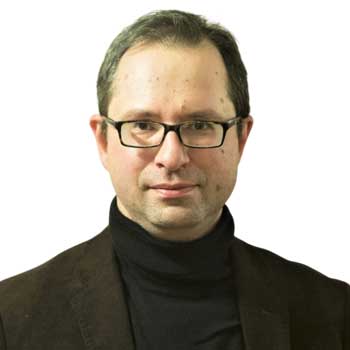
Professor Alexei M. Sivertsev is a professor at DePaul University’s Department of Religious Studies. He received his BA from the Historical Archival Institute, Russia State University for the Humanities, and MA and Ph.D. in Hebrew and Judaic studies from New York University. His research focuses on the study of Jewish cultural dynamics in late antiquity. Sivertsev was awarded a Fulbright Distinguished Scholar fellowship for his project “Text and Image in the Sepphoris Synagogue Mosaic: Towards a Nonprogrammatic Reading.” He will explore the fifth-century synagogue floor mosaic in the city of Sepphoris in Lower Galilee and church mosaics in the neighboring sites of Horvat Kenes and Khirbet Bata, both in the vicinity of the present-day town of Carmiel. The project is part of a broader attempt to understand how a variety of religious, ethnic, and linguistic communities in late Roman Palestine constructed their symbolic environments and imagined themselves in relation to these environments.